
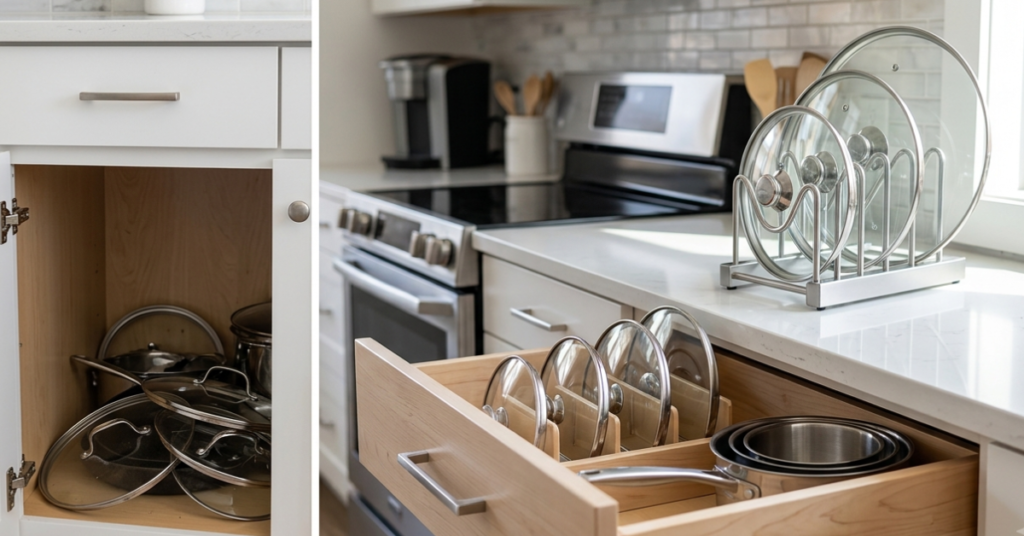
Installing a dedicated pot lid organizer eliminates cabinet clutter, protects delicate lid rims, and accelerates daily meal prep in compact kitchens. By converting underutilized vertical wall zones or cabinet door panels into structured holding slots, homeowners immediately reclaim up to 40 percent of valuable shelf space.
Selecting and Installing the Ultimate Pot Lid Organizer
Pot lid organizer Modern kitchens require strategic organization systems that handle heavy cookware while keeping everyday tools within easy arm’s reach.
+———————————————————————————–+
| POT LID ORGANIZER SELECTION MATRIX |
+————————–+———————–+——————————–+
| Organizer Type | Best Application | Key Operational Benefit |
+————————–+———————–+——————————–+
| Cabinet Door Racks | Shallow Cabinets | Reclaims zero-utility door space|
| Pull-Out Drawer Inserts | Deep Base Drawers | Full visibility & soft closure |
| Expandable Shelf Racks | Open Counter/Shelves | Adjustable slot spacing width |
| Wall-Mounted Rails | Backsplash Zones | Instant cooking line access |
+————————–+———————–+——————————–+
Cabinet Door-Mounted Racks
- Space Efficiency: Reclaims internal door panel surfaces without reducing interior shelf volume.
- Load Capacity: Best suited for lightweight glass, aluminum, and thin stainless steel lids.
- Installation Complexity: Requires short wood screws or heavy-duty acrylic adhesive tracks.
Deep Drawer Divider Inserts
- Space Efficiency: Holds lids upright inside deep base drawers alongside corresponding pots and pans.
- Load Capacity: Accommodates heavy cast iron, toughened glass, and large pressure cooker lids securely.
- Installation Complexity: Features drop-in tension frames or adjustable slot dividers requiring zero drilling.
Expandable Countertop & Shelf Frames
- Space Efficiency: Sits inside wide base cabinets or directly on food prep countertops.
- Load Capacity: Handles high weight loads due to flat, full-surface base contact.
- Installation Complexity: Free-standing assembly with customizable steel wire divider pegs.
Spatial Challenges in Modern Bangladeshi Kitchens
Pot lid organizer Managing meal preparation in urban apartments across Dhaka, Chattogram, and other major metropolitan areas presents distinct layout constraints.
Daily cooking practices involve large dekchis, heavy karahis, pressure cookers, and multiple saucepans. Stacking these items vertically creates unstable piles where extracting a bottom pot causes loud clatter, rim denting, or chipped glass lids.
Furthermore, elevated ambient humidity and regular steam production during cooking make enclosed, unventilated cabinets prone to dampness.
Material Engineering & Hardware Standards for Humid Climates
Pot lid organizer Selecting durable hardware requires evaluating material composition rather than focusing strictly on upfront costs. Kitchen fittings must endure constant exposure to steam, spice vapors, ambient moisture, and frequent handling.
- Grade SS304 Stainless Steel: The gold standard for humid environments, offering complete rust immunity, superior structural rigidity, and easy cleaning.
- Powder-Coated Carbon Steel: Provides strong resistance against physical impacts and moisture provided the outer polymer coating remains intact without deep scratches.
- Electroplated Chrome Wire: Suitable for budget applications but vulnerable to micro-flaking and rust spot formation when subjected to continuous steam exposure.
When evaluating slide-out mechanisms or door-mounted frames, ensure all structural joints feature full perimeter welds rather than light spot soldering. High-grade construction prevents frame sagging over time, ensuring dividers maintain strict vertical alignment even under full load capacity.
Integrating Pot Lid Racks with Modular Kitchen Accessories
Achieving maximum workflow efficiency requires integrating your pot lid holder into a comprehensive layout containing specialized modular kitchen accessories. Combining complementary hardware systems eliminates dead storage zones across base, upper, and corner cabinetry.
For instance, installing a dedicated lid rack directly above or adjacent to a heavy-duty pull-out drawer basket establishes a streamlined cooking workstation. Cooks can extract a frying pan or stockpot with one hand while selecting the exact matching lid with the other, eliminating prep delays.
+———————————————————————————–+
| INTEGRATED MODULAR STORAGE LAYOUT MODEL |
+———————————————————————————–+
| [ Upper Cabinets ] -> Slim Spices & Overhead Glassware Storage |
| [ Counter Top ] -> Active Prep Zone & Wall-Mounted Hanging Racks |
| [ Door Panels ] -> Mounted Pot Lid Organizer & Board Holders |
| [ Deep Drawers ] -> Heavy Cookware Baskets with Adjustable Dividers |
| [ Corner Spaces ] -> Revolving Baskets & Blind Corner Magic Trays |
+———————————————————————————–+
In blind corner cabinets where accessibility is traditionally restricted, pairing lid dividers with a smooth revolving basket maximizes space usage. Similarly, placing washing-adjacent accessories near a high-grade single bowl sink creates a fast, hygienic drying line for freshly washed lids before they are put away.
Comparing Popular Kitchen Storage Hardware Options
Building an organized cooking space requires selecting hardware tailored to specific storage tasks. The matrix below outlines how primary storage components compare in performance, load capabilities, and spatial efficiency.
| Storage System | Primary Function | Structural Advantage | Ideal Kitchen Size |
| Pot Lid Organizer | Keeps glass and metal lids upright | Prevents rim scratching and surface clutter | Compact to Medium |
| Pull-Out Wire Basket | Stores heavy pots and saucepans | Full-extension soft-close drawer slides | Medium to Large |
| Corner Revolving Unit | Utilizes hidden blind corner space | 270-degree rotation for fast access | Any Layout |
| Vertical Spice Rack | Houses oil bottles and spice jars | Ultra-slim footprint fits narrow gaps | Compact Layouts |
| Under-Sink Organizer | Holds cleaning agents and sponges | Moisture-resistant framework around pipes | Any Layout |
Smart Ergonomic Workflows: The Three-Zone Kitchen System
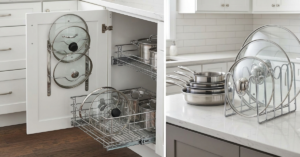
An organized kitchen relies on ergonomic principles that structure storage around natural cooking movements. Dividing your kitchen into dedicated functional zones drastically reduces unnecessary steps during busy meal preparation.
Zone 1: Cleaning & Washing Station
- Houses the primary sink, under-sink waste bins, and overhead drying racks.
- Position lid organizers intended for damp, freshly washed items within this zone to prevent water drips on main prep counters.
Zone 2: Active Preparation & Storage Zone
- Houses cutting boards, knives, drawer dividers, and everyday spice racks.
- Integrate door-mounted lid holders on upper or lower cabinets directly within reach of your primary prep surface.
Zone 3: Active Thermal & Cooking Zone
- Houses gas stoves, built-in hobs, range hoods, and primary cookware drawers.
- Locate deep base drawers equipped with vertical lid racks within arm’s reach of the cooktop for instant access during active frying or boiling.
Step-by-Step Installation & Cabinet Measuring Guide
Follow this standardized procedure to ensure perfect alignment, robust weight support, and smooth operation when installing door-mounted or drawer-inserted pot lid organizers.
Step 1: Measure Clearances and Hinges
Measure internal cabinet height, width, and depth using a steel tape measure. Subtract the projection distance of cabinet door hinges, internal shelving lips, and face frame overlaps to identify your true usable clear opening.
Step 2: Test Lid Depth and Profile Offset
Place your largest, most deeply domed pot lids onto the organizer frame. Measure the total operational depth from the rear mounting surface to the tip of the highest lid handle to ensure the cabinet door shuts completely without obstruction.
Step 3: Mark Mounting Anchor Points
Position the organizer frame against the cabinet door or internal wall. Use a spirit level to verify perfect vertical alignment, then mark screw hole centers using a fine tip marker or center punch tool.
Step 4: Secure Hardware and Load Test
Drill pilot holes using a drill bit sized slightly smaller than your mounting screws to prevent wood splitting. Secure the organizer tightly, inspect frame stability, and load lids gradually from lightest to heaviest to verify load capacity.
Critical Mistakes to Avoid When Purchasing Kitchen Organizers
Achieving a durable, highly efficient kitchen layout requires avoiding common hardware purchasing errors that lead to premature wear or spatial frustration.
Pro Tip: Never measure cabinet dimensions based on exterior box measurements. Always measure interior usable space between hinges, shelf lips, and slide mechanisms.
- Ignoring Door Hinge Clearance: Standard concealed cabinet hinges project inside the cabinet box by up to 30mm. Failing to account for hinge projection prevents door-mounted organizers from closing flush.
- Choosing Low-Grade Electroplated Metals: Installing cheap wire racks without true SS304 stainless steel construction in humid kitchens causes rapid rust staining on custom wooden cabinetry within months.
- Overloading Drawer Slide Capacities: Exceeding the rated dynamic weight capacity of drawer runners causes premature ball-bearing failure, drawer sagging, and harsh opening resistance.
- Misjudging Lid Handle Depth: Deeply domed glass lids or oversized loop handles require wider slot spacing than flat aluminum lids. Verify adjustable divider capability before purchasing fixed wire frames.
Future Trends in Smart Kitchen Storage (2026 & Beyond)
As urban apartment spaces continue to favor minimalist, highly integrated interior designs, kitchen organization hardware is evolving to meet higher standards of functionality and aesthetics.
- Concealed Magnetic Docking Rails: Flush-mounted magnetic backing strips integrated into cabinet door interiors allow stainless steel lids to snap securely in place without visible wire baskets.
- Anti-Microbial Nano Coatings: Advanced surface treatments applied to wire pull-outs and lid slots inhibit bacterial growth and prevent grease film accumulation in high-moisture cooking zones.
- Modular Click-In Divider Tracks: Fully customizable drawer insert tracks allow users to adjust slot width instantly without tools as their cookware collection changes over time.
- Ultra-Quiet Soft-Close Dampeners: Heavy-duty slide mechanisms feature multi-stage hydraulic dampening, preventing glass lids from rattling or clashing during quick drawer closures.
Installing a dedicated pot lid organizer paired with high-quality modular kitchen storage hardware immediately transforms cramped cooking spaces into efficient, organized, and enjoyable culinary environments.
Next Steps & Resource Directories
Browse Full Directories
[Main Hub] > [Kitchen Appliances & Modular Fittings]
Related Articles
