
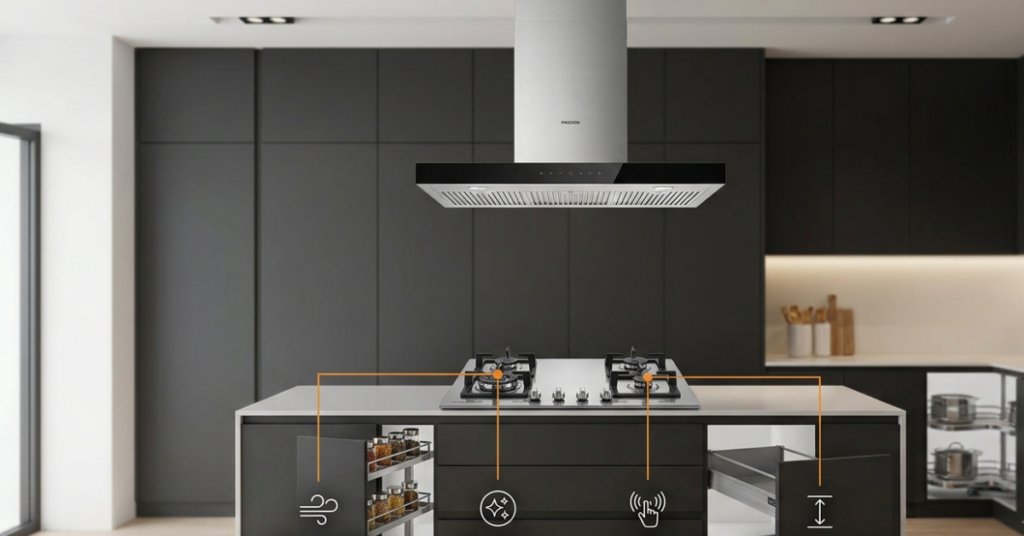
High-heat Bangladeshi cooking requires powerful ventilation to remove airborne grease, steam, and spice fumes before they settle on kitchen surfaces. Selecting a high-performance luxury kitchen hood safeguards indoor air quality while protecting cabinet finishes and countertop investments.
Core Selection Criteria for High-Performance Kitchen Hoods
Luxury kitchen hood Choosing the right kitchen ventilation system requires evaluating mechanical specifications against daily cooking intensity.
Luxury kitchen hood A primary factor when evaluating any chimney is the suction power kitchen hood rating measured in cubic meters per hour ($m^3/hr$). For typical apartment kitchens in Dhaka or Chittagong, minimum motor ratings should range between 1200 m³/hr and 1500 m³/hr.
Luxury kitchen hood Heavy exposure to moisture, salt, and heat demands food-grade SUS304 stainless steel or toughened tempered glass construction. Cheaper painted sheet metals corrode rapidly in humid tropical climate conditions.
Luxury kitchen hood High-capacity extraction must operate without generating intolerable acoustic noise throughout the residence.
Pro Tip: When selecting a chimney, verify that the noise rating remains below 60 dB at highest suction settings to ensure comfortable family conversations during meal preparation.
[INSERT VISUAL ASSET HERE: [PURE PHYSICAL PHOTOGRAPHY] – High-end modern Bangladeshi kitchen featuring a sleek wall-mounted slanted luxury kitchen hood with stainless steel accents above a glass top gas burner, showing clean airflow intake indicators and soft LED warm lighting]
Understanding Suction Power and Motor Performance in Bangladeshi Cooking
Cooking traditional Bengali dishes involves high-temperature oil frying, mustard oil heating, and rich spice roasting. These techniques release dense airborne grease droplets and microscopic spice particles that float across open-plan apartments. High-velocity extraction traps these particles at the cooktop before they contaminate adjacent spaces.
An effective extraction system creates negative air pressure directly above the cooking burners. Calculating proper motor strength depends on total room volume, ceiling height, and ducting length. Longer duct runs with multiple bends require higher static motor pressure to prevent air backdrafts.
Motors in premium chimneys utilize copper-winding assemblies engineered for continuous high-temperature duty. Internal thermal overload protection prevents motor burnout during extended cooking sessions. High-efficiency impellers maintain stable air displacement without drawing excessive electrical wattage.
Comparing Hood Form Factors: Finding the Best Kitchen Hood in Bangladesh
Selecting the best kitchen hood in bangladesh involves matching physical appliance form factors with structural cabinet layouts. Different hood styles serve specific room dimensions and cooking workflows.
- Slanted Glass Range Hoods: Angled glass construction offers superior head clearance over active burners while creating a striking modern visual statement. A slanted kitchen hood bd installation directs rising smoke into top intake slots, making it ideal for compact city apartments.
- T-Shape Canopy Chimneys: T-shape models feature a wide flat extraction box beneath a central vertical duct column. They provide maximum surface coverage for four-burner stoves and spacious open-plan kitchen setups.
- Under-Cabinet Slim Hoods: Slim under-cabinet designs tuck beneath existing wall storage units to conserve limited vertical space. While budget-friendly, high-heat frying requires dual-motor slim configurations to ensure adequate smoke removal.
- Island Range Hoods: Suspended directly from ceiling joists above freestanding kitchen islands, these hoods offer 360-degree smoke capture. They function as dramatic central design elements in spacious luxury residences.
[INSERT VISUAL ASSET HERE: [PURE INFRASTRUCTURE DIAGRAM] – Technical side-by-side dimensional layout diagram comparing T-Shape, Slanted Glass, and Under-Cabinet kitchen hood installations relative to cooktop height and cabinet clearances]
Filter Technologies & Maintenance: Baffle vs. Charcoal vs. Auto-Clean
Filtration efficiency determines how effectively a chimney captures grease while maintaining unrestricted airflow over extended periods. Understanding filter mechanics helps prevent premature motor strain.
Stainless steel baffle filters utilize curved overlapping blades to force rising smoke into rapid directional changes. Heavier grease particles separate from the air stream and drip into dedicated collection reservoirs. Baffle filters resist clogging far better than thin mesh filters and tolerate frequent dishwasher cleaning.
Ductless installations rely on activated carbon charcoal filters to absorb lingering spice odors before recirculating purified air back into the kitchen. Charcoal media cannot be washed and requires replacement every four to six months depending on cooking frequency.
Selecting an auto-clean kitchen hood drastically simplifies routine maintenance. Internal heating coils melt solidified grease inside the motor casing at the push of a button, draining oil directly into a removable tray.
Warning: Never operate your chimney without the primary baffle filters or oil collector in place, as airborne grease can settle on exposed electrical wiring and pose a fire hazard.
Integrating Ventilation with Modern Modular Kitchen Storage
A well-designed cooking space coordinates appliance placement with surrounding storage accessories to streamline daily workflows. Strategic cabinet planning maximizes usable counter space and reduces meal preparation stress.
Maintain a clearance distance between 65 centimeters and 75 centimeters between the gas stove burners and the bottom edge of the hood. Mounting the chimney too high degrades extraction efficiency, while mounting it too low creates thermal hazards and limits cooktop visibility. Surrounding upper cabinets should flank the hood without blocking exhaust airflow.
Pairing ventilation with smart cabinet fittings transforms functional storage efficiency. Installing a dedicated drawer spice rack near the cooktop keeps seasonings organized and protected from steam exposure. Deep pull-out baskets accommodate heavy cookware, while vertical pantries organize dry ingredients.
Isolate raw food preparation areas from washing zones to preserve hygiene standards. Equipping the washing area with a heavy-duty double bowl sink enables simultaneous food rinsing and dish cleanup without counter congestion. Proper chimney airflow prevents steam from drifting toward clean prep surfaces.
Market Price Landscape: Modern Kitchen Chimney Price in BD (2026 Guide)
Understanding price tiering allows homeowners to align budget choices with long-term appliance performance. Evaluating the modern kitchen chimney price in bd reveals three main market segments across local retailers.
Budget entry-level options range from BDT 12,000 to BDT 22,000 and primarily include basic slim under-cabinet units or standard manual T-shape chimneys. These models offer suction capacities between 800 m³/hr and 1000 m³/hr, making them suitable for light cooking demands in small apartments.
Mid-range performance chimneys span from BDT 23,000 to BDT 45,000, featuring durable SUS304 stainless steel, touch controls, motion sensors, and thermal auto-clean systems. Suction ratings between 1200 m³/hr and 1400 m³/hr make this tier the sweet spot for typical Bangladeshi family cooking.
Luxury high-end units range from BDT 46,000 to BDT 95,000 or higher. Investing in a premium luxury kitchen hood price in BD setup delivers whisper-quiet BLDC motors, suction exceeding 1500 m³/hr, and sophisticated tempered glass styling.
[INSERT VISUAL ASSET HERE: [PURE UI WALKTHROUGH] – Feature and price tier breakdown comparison interface showing entry-level, mid-range, and luxury kitchen hood specifications, suction power metrics, and control interface options]
5 Common Installation and Usage Mistakes to Avoid
Avoiding frequent installation errors ensures optimal airflow and protects expensive kitchen equipment from early failure.
- Using Undersized Ducting Pipes: Connecting a high-capacity motor to flexible ducting under 150 millimeters in diameter chokes air discharge. Restricted ducting causes severe air turbulence, increasing operational noise and reducing extraction capacity.
- Excessive Duct Bends and Length: Running ductwork longer than 10 feet or adding multiple 90-degree elbows increases static resistance. Excessive bends force the motor to work harder, accelerating internal wear and reducing suction.
- Relying Solely on Wall Exhaust Fans: Substituting a dedicated chimney with a simple kitchen exhaust fan bd fails to capture grease at the stove top. Wall fans pull sticky oil vapors across ceilings, staining wall paint and upper cabinetry.
- Improper Wall Anchor Mounting: Mounting heavy T-shape or slanted chimneys onto hollow interior brick without solid expansion anchors causes structural instability. Motor vibrations gradually loosen weak wall fixings over time.
- Neglecting Regular Filter Cleaning: Allowing thick grease layers to accumulate on baffle blades blocks intake openings. Clogged filters restrict airflow and force the motor to draw higher current, increasing electricity bills.
Future Ventilation Trends: Smart Sensors, Motion Controls, and Silent Motors
Modern ventilation technology continues to advance, focusing on touchless operation and whisper-quiet performance. These innovations create more comfortable and energy-efficient kitchen environments.
Touchless gesture sensors enable users to turn on the hood and adjust fan speeds with simple hand waves across the front panel. This hands-free control prevents oil smudges on control glass while handling wet or messy cooking ingredients.
Automated heat and smoke sensors detect cooking intensity and automatically modulate motor speed in real time. The chimney ramps up extraction during high-heat searing and reduces speed during low-heat simmering without manual intervention.
Brushless DC (BLDC) motor technology replaces traditional AC motors to deliver higher static suction with up to 50% less energy consumption. BLDC motors operate with minimal magnetic friction, maintaining noise levels under whisper-quiet thresholds.
Frequently Asked Questions About Kitchen Exhaust and Ventilation in BD
Q1: What is the main operational difference between a kitchen hood and a wall exhaust fan?
A wall exhaust fan merely evacuates ambient air after smoke has already dispersed across the ceiling. A kitchen hood hangs directly over the cooktop to capture grease, odor, and steam at the source before vapors contaminate the home.
Q2: How frequently should stainless steel baffle filters be washed?
For daily Bangladeshi cooking involving oil frying and spice roasting, wash baffle filters every two to three weeks using warm water and grease-cutting liquid soap.
Q3: Can ducted chimneys be installed in rented apartment units?
Ducted chimneys require an exterior wall opening. If structural drilling is prohibited by landlords, opt for a ductless chimney configured with activated charcoal filters that purify and recirculate air indoors.
Q4: What motor capacity is recommended for a standard 4-burner gas stove?
Four active gas burners produce substantial heat and smoke spread. A motor rated between 1200 m³/hr and 1500 m³/hr is recommended to maintain complete smoke capture across all active burners.
Proper ventilation transforms a smoky prep area into an inviting culinary workspace that stays fresh and elegant for years to come.
Next Steps & Resource Directories
Browse Full Directories
[Main Hub] > [Kitchen Appliances & Modular Fittings]
Related Articles
- Stainless Steel Kitchen Basket Benefits
- Best spice rack stainless steel for Modern Kitchens Guide
- Kitchen Basket Price: Stainless Steel Buying Guide
- Best Stainless Steel Shelves for Modern Kitchen Storage
