
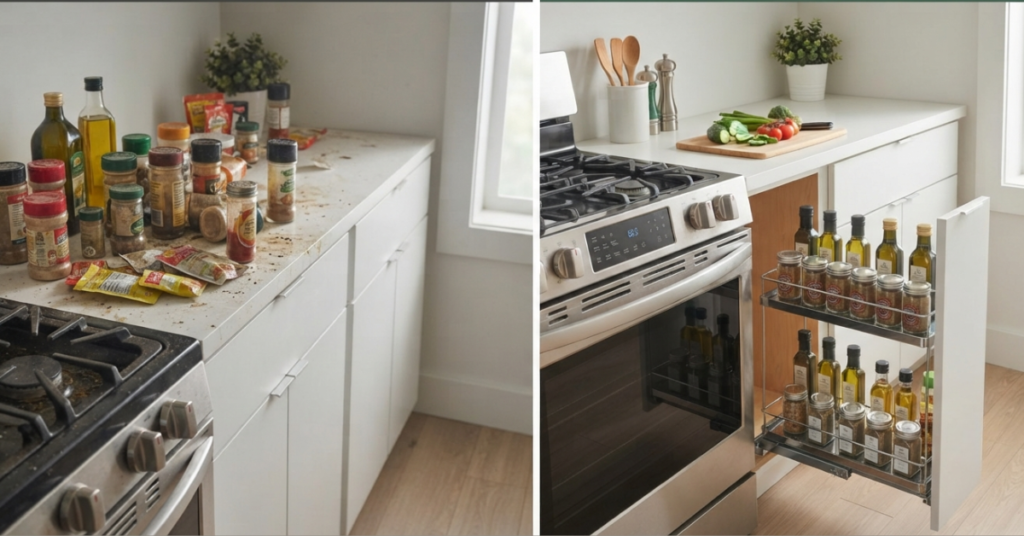
Transforming a cramped urban kitchen into a high-efficiency cooking space requires eliminating countertop clutter and streamlining access to daily essentials. Installing a dedicated spice rack organizer consolidates loose condiment jars, prevents oil grime buildup, and cuts meal preparation time by up to 30 percent.
Technical Breakdown: How a Pull-Out Spice Rack Optimizes Cabinet Space
Spice rack organizer Integrating a dedicated pull-out spice rack into base cabinetry solves the spatial constraints typical of urban apartments. Traditional kitchen layouts rely on wide open shelving, which leads to double-row stacking where smaller condiment jars get lost behind bulky containers.
+———————————————————————–+
| CABINET DEPLOYMENT FRAME |
+———————————————————————–+
| [Side Rail Mounting] ==> [Ball-Bearing Soft-Close Runners] |
| | |
| v |
| +—————————————————————–+ |
| | UPPER LEVEL: Small Spice Jars & Dry Herb Containers | |
| +—————————————————————–+ |
| | LOWER LEVEL: Heavy Oil Bottles, Soy Sauce & Bulk Condiments | |
| +—————————————————————–+ |
| | |
| [Removable Tray Liners] <== [Drip Containment Zone] |
+———————————————————————–+
Motion Mechanics and Load Distribution
Spice rack organizer The core performance of a pull-out spice organizer depends on its slide mechanism. High-grade ball-bearing runners mounted on side or bottom panels allow the unit to extend fully out of the cabinet box.
- Soft-Closing Dampeners: Hydraulic dampeners absorb closing force, preventing glass jars from knocking together or tipping over when pushed shut quickly.
- Vertical Weight Balancing: Heavy liquids, such as mustard oil and vinegar bottles, sit on the lower tier to keep the center of gravity low, while lightweight spice containers occupy upper shelves.
- Full-Extension Clearance: Slide rails extend 100 percent beyond the cabinet frame, providing unobstructed overhead access to back-row jars without reaching into dark corners.
Space Efficiency Comparison
| Storage Metric | Traditional Open Shelf | Overhead Wall Cabinet | Pull-Out Spice Organizer |
| Usable Cabinet Depth | 40% (back row hidden) | 50% (height restricted) | 95% (full linear access) |
| Required Cabinet Width | 450 mm – 600 mm | 300 mm – 600 mm | 150 mm – 300 mm |
| Access Speed | Slow (requires rearranging) | Moderate (requires reaching) | Fast (single motion extend) |
| Risk of Jars Tipping | High | Medium | Low (guided wire frame) |
| Spill Containment | Spreads across wood shelf | Difficult to clean | Isolated to removable tray |
Practical Benefits for High-Intensity Cooking Workflows
Spice rack organizer Traditional Bangladeshi cooking relies on an array of ground spices, whole aromatics, pastes, and cooking oils added in quick succession during the phaorim or baghar tempering process.
TRADITIONAL WORKFLOW:
[Stove] —> Walk to Pantry —> Search Shelf —> Grab Jar —> Walk Back —> [Burned Spices!]
OPTIMIZED WORKFLOW:
[Stove] —> Slide Pull-Out Rack (Arm’s Reach) —> Grab Jar —> [Perfect Tempering]
Eradicating Countertop Chaos
- Reclaiming Work Surfaces: Moving 10 to 20 spice jars off the countertop onto a concealed pull-out rack instantly frees up preparation space for cutting vegetables and processing proteins.
- Eliminating Oil Grime: Spices kept near open cooking zones attract airborne grease and moisture, forming a sticky layer on glass surfaces. Storing them inside closed cabinets behind protective panels keeps containers clean.
- Preventing Cross-Contamination: Dedicated compartments isolate dry spice powders from liquid sauces, reducing the chance of sticky residue contaminating salt or turmeric jars.
Streamlining Meal Preparation Efficiency
Spice rack organizer A systematic layout directly accelerates meal execution. Grouping primary spices—turmeric, cumin, coriander, red chili, and mustard seeds—on the top tier allows for instant visual identification during high-heat cooking.
Pro Tip: Position your spice organizer directly to the left or right of the primary stove unit. Keeping essential cooking seasonings within an arm’s reach of 300 mm to 450 mm prevents delay during sensitive heat-tempering phases.
Step-by-Step Guide: Selecting and Planning Installation
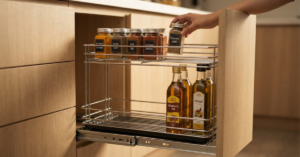
Spice rack organizer Selecting the correct hardware requires precise evaluation of cabinet dimensions, load tolerances, and material compositions. Follow this structured planning sequence before purchasing hardware.
STEP 1: Measure Frame
┌─────────────────────────┐
│ Cabinet Inner Width │
│ Cabinet Depth & Height │
└────────────┬────────────┘
│
v
STEP 2: Evaluate Load
┌─────────────────────────┐
│ Calculate Glass Weight │
│ Verify Runner Capacity │
└────────────┬────────────┘
│
v
STEP 3: Select Material
┌─────────────────────────┐
│ SUS304 Stainless Steel │
│ Soft-Close Rails │
└────────────┬────────────┘
│
v
STEP 4: Mount & Align
┌─────────────────────────┐
│ Fasten Side Rails │
│ Adjust Door Face Panels │
└─────────────────────────┘
Measuring Cabinet Apertures
Spice rack organizer Accurate measurements prevent purchasing hardware that conflicts with cabinet hinges, door frames, or internal piping.
- Internal Clear Width: Measure the narrowest distance inside the cabinet from wall to wall, accounting for door hinge protrusion if the rack mounts behind a hinged door.
- Internal Depth: Measure from the rear panel to the inside edge of the front door frame. Standard modular base cabinets require a minimum internal depth of 450 mm to 500 mm.
- Vertical Clearance: Measure the total internal height from the bottom panel to the top shelf or drawer slide above, ensuring tall oil bottles fit comfortably on the lower basket level.
Hardware Specification Checklist
- Steel Grade: Choose SUS304 stainless steel or multi-layer chrome-plated carbon steel to resist corrosion caused by high humidity and salty air.
- Weight Rating: Select runners rated for at least 20 kg to 30 kg of dynamic load capacity to prevent sag when fully loaded with glass containers.
- Tray Design: Ensure the unit features solid ABS plastic or stainless steel drip trays at the base of each tier to catch loose powder and oil drips.
Spice rack organizer For comprehensive cabinetry layouts, browse the side basket for 150-200-250-300mm cabinet directory to match your specific interior frame dimensions.
Integrating Spice Racks with Broader Modular Systems
A spice rack organizer works best as part of a complete modular layout. Combining specialized storage units ensures every zone of the kitchen handles a specific task without cluttering main work surfaces.
Coordinating Cooking and Washing Zones
- Primary Cooking Zone: Position a pull-out spice rack directly beside a high-efficiency 2-burner gas stove to keep seasonings, oils, and cooking utensils within direct reach while cooking.
- Washing and Preparation Zone: Maintain a clear separation between dry condiment storage and wet washing areas. Ensure the sink station uses a luxury kitchen sink equipped with bottom grids to control water splashing away from surrounding wooden cabinetry.
- Corner Utilization: Link linear base pull-outs with blind corner solutions like a corner basket to turn dead corner space into accessible storage for large cookware and bulk refills.
+———————————————————————–+
| OPTIMIZED BASE LAYOUT |
+———————————————————————–+
| [Corner Carousel] | [2-Burner Stove] | [Pull-Out Spice Rack] |
| (Bulk Storage) | (Cooking Zone) | (Arm’s Reach Access) |
|———————|——————–|—————————-|
| [Base Baskets] | [Gas Line Space] | [Lower Tray Oil Storage] |
+———————————————————————–+
Balancing Vertical and Drawer-Based Systems
For tight spaces, choosing between door-mounted pull-out racks and in-drawer dividers depends on cabinet geometry:
- Vertical Pull-Out Units: Ideal for narrow base gaps (150 mm to 300 mm wide). They maximize total vertical height and keep tall oil bottles upright.
- Horizontal In-Drawer Racks: Best installed in wide shallow drawers directly under the cooktop. They lay spice jars flat with labels facing upward for fast visual scanning.
- Wall-Mounted Hanging Racks: Excellent for rented spaces where cabinet modifications are limited. Mounted on backsplash rails, they keep counters clear without permanent cabinet alterations.
Device-Specific & Layout Installation Guides
Spice rack organizer Different kitchen layouts require tailored mounting approaches. Whether fitting out a new modular installation or retrofitting existing wooden cabinets, follow these installation procedures.
RETROFIT INSTALLATION SEQUENCE:
- Clear Cabinet Base --> 2. Position Track Template --> 3. Secure Rail Screws
- Mount Frame Chassis --> 5. Attach Front Panel --> 6. Test Glide Mechanism
Retrofitting Existing Cabinetry
Spice rack organizer Upgrading traditional wooden cabinets with modern pull-out hardware requires minimal tool usage.
- Clear and Clean: Remove existing wooden shelves inside the base cabinet to create an open cavity from the floor panel to the top countertop support.
- Track Placement: Align the slide rails against the bottom panel or right-side interior wall. Use a spirit level to ensure the tracks sit perfectly parallel to prevent binding during movement.
- Securing Fasteners: Screw the heavy-duty mounting brackets into the cabinet casing using rust-resistant wood screws.
- Attaching the Frame: Drop the wire basket chassis into the slide rails until the locking clips engage with a distinct click.
- Door Panel Alignment: If connecting the rack to a pull-out cabinet door, attach the front brackets to the wooden door panel and adjust the alignment screws until the door sits flush with adjacent cabinets.
Corner Cabinet Configurations
Spice rack organizer Standard L-shaped layouts often leave dark, hard-to-reach dead corners. Pair narrow spice pull-outs with rotating hardware to fully utilize corner volumes.
- 180-Degree Half-Moon Trays: Pivot out from blind corners to bring heavy spice jars and sauce bottles forward.
- 360-Degree Revolving Baskets: Allow full rotational access in square corner cabinets, ideal for storing secondary bulk spice containers.
Common Mistakes to Avoid & How to Fix Them
Spice rack organizer Improper installation or loading can cause smooth mechanisms to bind, sag, or fail prematurely. Review these common mistakes and corrective actions.
+——————-+———————————–+———————————-+
| FAILURE MODE | ROOT CAUSE | CORRECTIVE ACTION |
+——————-+———————————–+———————————-+
| Drawer Binding | Misaligned Slide Tracks | Re-level rails with shims |
| Front Panel Sag | Excess Lower Weight | Shift oil bottles to rear base |
| Rattle Noise | Loose Jars on Wire Frame | Insert silicone grip liners |
| Rust / Corrosion | High Humidity + Salt Exposure | Upgrade to SUS304 stainless frame|
+——————-+———————————–+———————————-+
Overloading and Weight Misdistribution
- The Issue: Concentrating heavy glass bottles on the top tier causes top-heavy instability, putting excessive strain on upper slide bearings and making the unit feel unsteady.
- The Fix: Store lightweight plastic containers and dry spice jars on the upper rack, while placing heavy glass oil cruets, soy sauce jugs, and vinegar bottles on the bottom tier over the main load-bearing rails.
Neglecting Environmental Conditions
- The Issue: Installing mild steel or low-grade chrome wire racks in high-humidity kitchens leads to rust spots around weld joints within months.
- The Fix: Select powder-coated frames or solid SUS304 stainless steel construction. Wipe down internal metal components once a month with a soft, dry cloth to prevent salt and moisture accumulation.
Future Trends in Kitchen Organization for 2026
Spice rack organizer Modern interior architecture continues to prioritize concealed, high-efficiency storage solutions that maintain sleek, unencumbered room aesthetics.
Concealed Minimalism and Handleless Hardware
- Push-to-Open Mechanical Systems: Modern designs eliminate external handles, using spring-assisted push latches to deploy pull-out spice racks with a light tap of the knee or hand.
- Integrated LED Strip Lighting: Micro LED channels recessed into top cabinet frames light up internal spice racks automatically when opened, improving visibility in dimly lit spaces.
- Modular Magnetic Organizers: Adjustable magnetic dividers allow users to reconfigure internal basket layouts on the fly, accommodating different jar sizes without rattling.
Sustainable and Hygienic Material Innovation
- Antimicrobial Coatings: Next-generation wire baskets use non-toxic antimicrobial powder coatings that stop bacterial growth caused by humidity and accidental food spills.
- Eco-Friendly Composites: High-density bamboo and recycled composite tray liners offer durable, moisture-resistant alternatives to petroleum-based plastics.
Investing in a high-quality spice rack organizer turns chaotic cooking zones into clean, organized, and high-efficiency workspaces tailored for daily meal preparation.
Footer & Resource Directories
Browse Full Directories
[Kitchen Park BD Hub] > [Cabinet Hardware Category]
Related Articles
- kitchen accessories 900mm wire pull out drawer basket for cabinet storage rack
- 150mm 2 Shelf Drawer Basket for Kitchen Cabinet
- 3 Shelves Kitchen Cabinet Storage Organizer Multi-Functional Metal Wire Chrome Plating Drawer Basket
- 150mm 2 Shelf Drawer Basket for Kitchen Cabinet
