
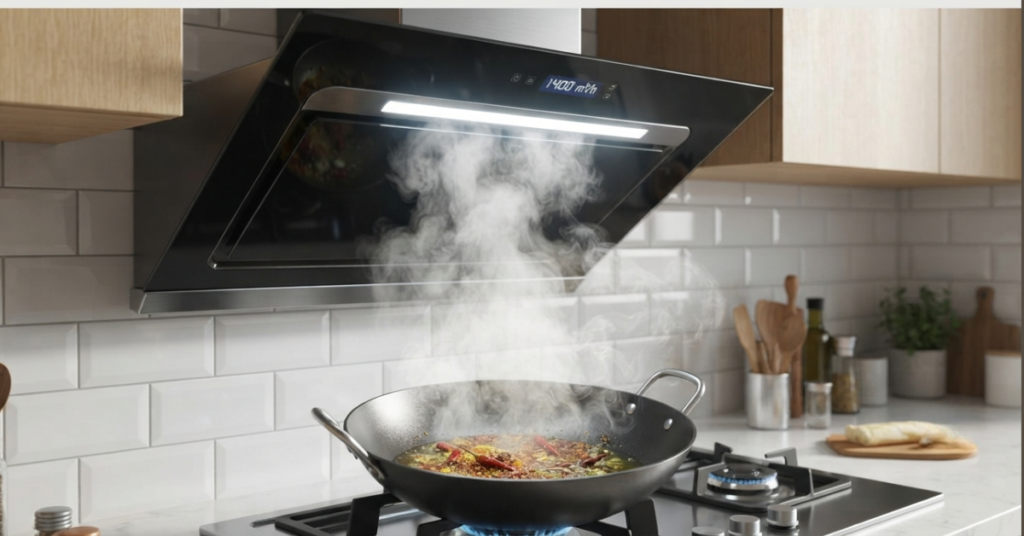
Cooking in a Bangladeshi apartment involves high-heat deep frying, mustard seed tempering, and slow-simmering aromatic curries that release dense airborne oil, steam, and pungent smoke.
Installing a powerful kitchen hood extracts greasy fumes instantly before they settle on tiles, discolor kitchen cabinets, or degrade indoor air quality.
This definitive 2026 buyer guide explores performance specs, filter designs, installation layouts, and pricing to help you build a clean, grease-free cooking space.
Core Extraction Mechanics: Built for Bangladeshi cooking needs.
South Asian culinary traditions place extreme demands on residential ventilation. Understanding motor mechanics, airflow metrics, and filtration engineering ensures your chosen extraction unit cleans the air efficiently under heavy daily use.
Airflow Metrics ($m^3/h$) and Motor Construction
A powerful kitchen hood requires the right airflow capacity to remove smoke, grease, and odors efficiently. Measured in $m^3/h$, 1,000–1,500 capacity is ideal for Bangladeshi cooking needs like frying and heavy spices.
powerful kitchen hood,1 Choose 100% copper-winding sealed motors for durability, heat protection, and reliable performance in humid kitchens.
Baffle Filters vs. Mesh Filters
Filter choice determines long-term extraction efficiency and maintenance workload:
- The absolute gold standard for oil-heavy cooking. Baffle filters consist of overlapping curved stainless steel baffles that force smoke-laden air to change direction rapidly.
- Heavy oil droplets separate from the airstream via centrifugal force and drop into an oil collection tray, leaving the air path clear.
- Composed of multiple layered mesh sheets.
- While cheaper, fine mesh pores clog rapidly when exposed to thick cooking grease, restricting motor airflow and requiring weekly scrubbing with chemical degreasers.
Thermal Auto-Clean Technology
Powerful kitchen hoods with thermal auto-clean technology simplify maintenance. A heating coil warms the motor area to 70°C–80°C, melting grease buildup into oil that drains into a removable collector cup, keeping performance efficient.
Technical Comparison: Range Hood Configurations
Selecting the correct structural design depends directly on your kitchen layout, cabinet configuration, and stove positioning.
| Hood Architecture | Optimal Airflow Range | Filter Efficiency | Mounting Location | Ideal Kitchen Layout |
| Wall-Mounted Chimney | 1,000 – 1,400 $m^3/h$ | High (SS Baffle) | Vertical Wall | Traditional linear or L-shaped counters against a perimeter wall |
| Island Hanging Hood | 1,200 – 1,600 $m^3/h$ | High (Baffle / Carbon) | Ceiling Suspended | Open-concept kitchens with central cooktop islands |
| Built-In Under-Cabinet | 700 – 1,100 $m^3/h$ | Medium to High | Inside Upper Cabinet | Compact apartments with full upper overhead cabinetry |
| Slimline Standard Hood | 500 – 800 $m^3/h$ | Low to Medium (Mesh) | Underside of Cabinet | Rental units or light cooking setups with budget constraints |
Island Hood vs Wall Mounted Hood: Which Setup Fits Your Home?
Powerful kitchen hood,Choosing between an island hood vs wall mounted hood requires analyzing structural mounting points, airflow dynamics, and architectural constraints.
+——————————————————————-+
| VENTILATION ARCHITECTURE COMPARISON |
+——————————————————————-+
| WALL-MOUNTED HOOD: Attached to perimeter wall, backed by tile. |
| --> Airflow bounded by wall, higher capture efficiency. |
| |
| ISLAND HOOD: Suspended from ceiling joists over central island. |
| --> Exposed 360 degrees to room cross-drafts, needs high CFM. |
+——————————————————————-+
Wall-Mounted Chimney Hoods
Wall-mounted units attach directly to a solid wall above the cooktop, with a decorative stainless steel chimney section concealing the flexible exhaust ducting.
Powerful kitchen hood,Because wall surfaces act as natural barriers, cross-drafts are minimized, directing rising thermal plumes directly into the capture canopy.
You can browse specialized wall-mounted cooker hoods designed for heavy-duty daily cooking to keep your perimeter tile walls completely oil-free.
Ceiling-Suspended Island Hoods
Island hoods hang freely from ceiling joists above a central kitchen counter island. Because island cooktops are exposed to 360-degree air movement from adjacent hallways and open living rooms, smoke disperses faster before reaching the intake canopy.
Consequently, island installations require at least 20% higher airflow capacity ($m^3/h$) and wider capture hoods than equivalent wall-mounted units to maintain equal extraction performance.
Essential Buying Criteria: Evaluating a Kitchen Chimney Hood BD
Powerful kitchen hood,Beyond raw power ratings, evaluating functional build parameters guarantees quiet operation, durability, and hassle-free daily usage.
Acoustic Comfort and Decibel Levels
A powerful kitchen hood combines high extraction with low noise. Premium models use advanced fans and vibration control to keep sound below 58–65 dB.
Controls: Gesture Sensors and Digital Touch
Modern kitchen environments require hands-free operation. Touch control panels with digital LED displays provide precise multi-speed fan control.
Gesture-sensing motion controls allow you to wave your hand left or right across infrared sensors to turn the unit on, adjust speed, or activate LED task lighting without touching glass surfaces with oil-stained hands.
Material Build and Structural Steel
Opt for SUS304 grade stainless steel backings paired with heat-toughened black tempered glass front panels,powerful kitchen hood.
Cheap steel alloys quickly pit and rust under high humidity, whereas SUS304 resists heat degradation, acidic spice vapors, and frequent wipe-downs with commercial degreasers.
Integrating Smart Storage and Modular Hardware with Ventilation

A modern, high-functioning culinary space balances heavy-duty smoke extraction with organized, ergonomic storage layouts.
powerful kitchen hood,Position high-frequency cooking tools right near the appliance zone to streamline food preparation.
+——————————————————————-+
| ZONE-BASED KITCHEN ERGONOMICS |
+——————————————————————-+
| [ Overhead Zone ] --> High-Capacity Extraction Chimney Hood |
| [ Cooktop Zone ] --> High-Efficiency Gas Hob / Induction Stoves |
| [ Base Cabinet ] --> Pull-Out Spice Racks & Deep Pan Baskets |
| [ Dead Corners ] --> Swing-Out Magic Corner Carousel Systems |
+——————————————————————-+
Cooktop Proximity and Base Storage
Placing key spice items directly adjacent to the cooking stove eliminates unnecessary movement during active cooking,powerful kitchen hood.
Installing vertical drawer spice racks inside 300mm base cabinets keeps oils, mustard seeds, and essential spices organized and accessible right when food hits hot oil.
Corner Utilization in L-Shaped Kitchens
L-shaped and U-shaped kitchens often feature awkward dead corners that trap unused items,powerful kitchen hood.
Incorporating heavy-duty magic corner systems maximizes corner storage depth, bringing heavy cookware and pots out smoothly without forcing you to bend into dark cabinet cavities.
Market Price Analysis: Kitchen Hood Price in BD (2026 Guide)
Evaluating the kitchen hood price in BD across different budget tiers helps you choose the right model without overspending.
powerful kitchen hood,Pricing varies depending on motor rating, auto-clean technology, and brand origin.
Budget Tier: BDT 11,000 – BDT 18,000
- Target Models: Standard slimline units and basic wall-mounted chimneys (Gazi, Rizco, Midea budget lines).
- Key Specs: Airflow of 700 to 1,000 $m^3/h$, push-button controls, aluminum mesh or basic baffle filters, manual cleaning required.
- Best For: Small apartment kitchens, rental properties, and light daily cooking setups.
Mid-Range Tier: BDT 18,500 – BDT 35,000
- Target Models: High-suction auto-clean chimney hoods (Rizco Luminous, Gazi Smiss, Midea Auto-Clean).
- Key Specs: Airflow of 1,100 to 1,400 $m^3/h$, thermal heat auto-clean, SS baffle filters, touch screens with gesture sensors, under 62 dB noise.
- Standard Bangladeshi family households with heavy daily frying, fish searing, and curry preparation.
- You can check modern auto-clean kitchen hood options to explore units in this sweet spot for durability and performance.
Premium & Luxury Tier: BDT 36,000 – BDT 112,000+
- Target Models: Premium imported chimney and island hoods (Fotile, Bosch, Swish).
- Key Specs: Airflow exceeding 1,500 $m^3/h$, dual-inverter brushless DC (BLDC) motors, ultra-quiet operation (<52 dB), smart app integration, specialized noise reduction.
- Best For: Open-plan luxury duplexes, architectural show kitchens, and large island cooktops requiring top-tier aesthetics and extraction power.
Installation Best Practices and Ducting Guidelines
powerful kitchen hood,Even the best kitchen hood in Bangladesh underperforms if installed incorrectly. Follow these rigid engineering guidelines during setup:
Mounting Height Above Cooktop
- Mount the bottom edge of the hood canopy 65 cm to 75 cm (26 to 30 inches) above the gas burner top.
- Mounting higher allows thermal smoke plumes to spill into the room, while mounting lower creates fire risks from high gas flames.
- Induction/Electric Hobs: Mount between 55 cm to 65 cm (22 to 26 inches) above the cooktop surface for maximum capture velocity.
Duct Routing and Pipe Diameter
Always use rigid or semi-rigid aluminum ducting rather than cheap flexible plastic pipes, which restrict airflow and trap grease in corrugated folds. Maintain a 150 mm (6-inch) pipe diameter throughout the exhaust run.
Minimize 90-degree elbows; every 90-degree bend reduces total suction capacity by roughly 10% to 15%. Direct ducting runs straight out through an exterior wall with a spring-loaded weather cap to prevent pest entry.
Common Installation & Operational Mistakes to Avoid
- Recirculating ductless hoods rely on activated charcoal filters that remove odors but fail to clear heat, steam, or dense oil smoke.
- Heavy South Asian cooking requires ducted external venting.
- Smoke and airborne grease linger in the room long after the burner is switched off.
- Always run the hood on low speed for 5 to 10 minutes after cooking finishes to purge remaining micro-particles.
- Reducing a 150 mm hood outlet down to a 100 mm wall pipe creates air backpressure, significantly increasing motor noise while cutting suction capacity in half.
- Relying on auto-clean cycles without draining the oil tray leads to overflow onto counter surfaces. Empty the collector cup monthly to maintain hygiene.
Maintenance and Care Checklist for Long Life
Regular maintenance keeps your extraction system operating at peak performance for years:
- Clean tempered glass panels and stainless steel housings with a microfiber cloth and mild dishwashing liquid. Avoid abrasive scouring pads that scratch glass coatings.
- Remove stainless steel baffle filters and soak them in hot water mixed with baking soda and dish soap for 20 minutes to dissolve built-up grease, then rinse thoroughly.
- Run the thermal heat auto-clean program for 10–15 minutes, allowing collected internal oils to drop into the rear collector tray, then wash the cup.
- Annual Professional Service: Check internal fan wheel balance, verify wiring integrity, and inspect ducting connections to ensure no grease leaks exist behind cabinetry.
Emerging Ventilation Trends in 2026
The residential kitchen ventilation sector continues to evolve with advanced smart technologies:
- BLDC Inverter Motors: Brushless Direct Current motors deliver up to 50% energy savings while automatically adjusting RPM based on duct static pressure resistance.
- Air Quality Sensor Auto-Start: Integrated PM2.5 and VOC sensors detect smoke particles automatically, turning on ventilation fan speeds without manual user input.
- Ultra-Slim Hidden Canopies: Built-in telescopic and slim-profile hoods retract flush into upper cabinetry when inactive, preserving seamless modern visual lines.
Next Steps & Resource Directories
Browse Full Directories
- Main Hub: Kitchen Park BD
- Category: Kitchen Appliances & Ventilation
Related Articles & Guides
- how to clean a kitchen hood the Right Way
- Modern kitchen hood: Smart Storage for Every Kitchen Today
- Kitchen Hood Service: Clean, Safe, and Efficient Cooking
- Top Benefits of Kitchen Hood for a Cleaner Home Kitchen
