
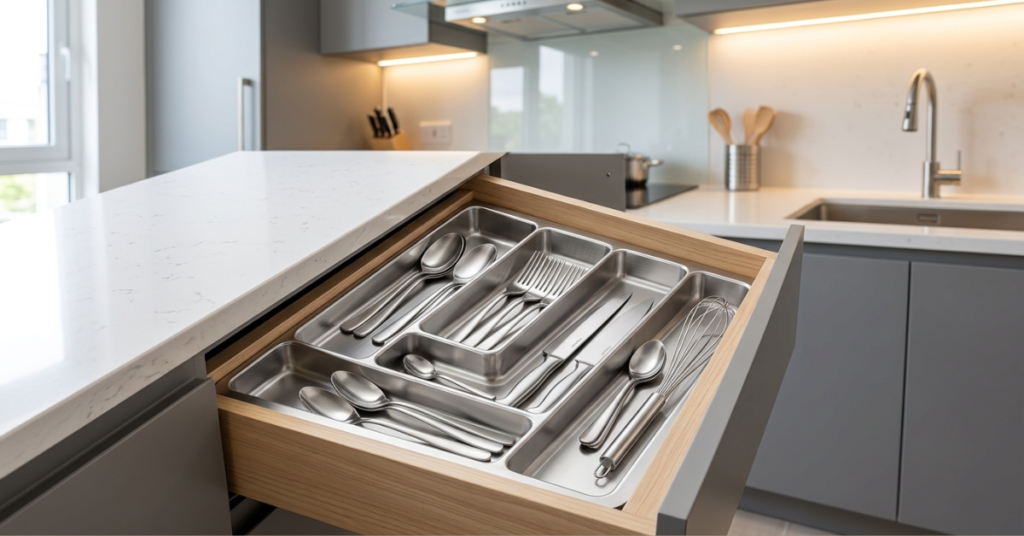
Upgrading kitchen cabinetry in high-humidity urban environments requires hardware that balances mechanical weight distribution with smooth movement. Heavy cookware, brass utensils, and drawer slides side mount daily spice storage subject cabinet tracks to continuous structural stress.
Technical Overview: How Side Mount Drawer Slides Work
Drawer slides side mount Side mount drawer slides anchor directly to the outer sides of the drawer box and the inner walls of the cabinet frame.
Drawer slides side mount This mounting configuration leaves a tiny, highly visible gap—typically 12.7 mm (1/2 inch)—between the cabinet wall and the drawer box on both sides.
- Load Distribution: Dual-side support transfers vertical downward force directly to the cabinet’s vertical side panels, preventing floor bowing in wide drawers.
- Extension Profiles: Available in 3/4-extension for budget setups or full-extension 3-fold profiles that bring the rear edge of the drawer completely outside the cabinet frame.
- Disengagement Mechanisms: Equipped with quick-release lever latches that allow you to lift the entire drawer box off its tracks without unscrewing the hardware.
Technical Specifications & Weight Capacity Matrix
Drawer slides side mount Selecting hardware for kitchen storage requires matching the hardware’s rated load capacity to the weight of your stored cookware.
| Slide Category | Rated Load Capacity | Recommended Usage Scenario | Core Mechanism |
| Light Duty Standard | 25 kg – 35 kg | Cutlery drawers, napkin storage, light spice trays | Single or dual ball-bearing, partial extension |
| Medium Duty Residential | 35 kg – 45 kg | Everyday dishware, small appliance drawers, pan storage | Full extension, 3-fold steel track, optional soft-close dampener |
| Heavy Duty Industrial | 50 kg – 90 kg+ | Deep pot drawers, heavy cast iron, bulk grain pull-outs | Cold-rolled steel, reinforced ball cages, hydraulic soft-closing |
Overloading drawer tracks past their rated capacity warps the outer steel channels, flattens the internal ball bearings, and causes structural binding. Always calculate drawer contents at 120% of estimated maximum weight when choosing slide ratings.
Soft Close vs. Self-Close vs. Standard Ball-Bearing Mechanisms
Drawer slides side mount Understanding the mechanical differences between slide closing mechanisms helps prevent premature hardware wear and avoids unnecessary noise in busy kitchens.
1. Soft Close Side Mount Drawer Slides
Drawer slides side mount Integrated hydraulic dampeners and spring-loaded catch hooks actively slow down the closing motion during the final 2 inches of travel.
- Vibration Prevention: Stops liquid spillage from unsealed jars or oil dispensers during rapid closing.
- Noise Dampening: Eliminates hard metal-on-wood impacts in open-plan apartment layouts.
- Hydraulic Seal Durability: High-grade fluid cylinders maintain resistance even during seasonal humidity changes.
2. Self-Closing Mechanisms
Drawer slides side mount Self-closing slides use internal spring tension to pull the drawer shut once it reaches the final stage of travel, but lack hydraulic dampeners. While they ensure drawers never remain slightly ajar, they can slam shut if pushed hard.
3. Standard Ball-Bearing Runners
Drawer slides side mount Standard runners rely on pure manual push-and-pull movement supported by greased steel ball bearings.
Measuring Cabinet Dimensions for Accurate Side Clearance
Drawer slides side mount Incorrect cabinet measurements cause most slide binding and alignment issues during installation. Side mount hardware requires exact lateral clearance to operate without friction.
1. Lateral Side Clearance
Drawer slides side mount Measure the internal width of the cabinet opening and the external width of your constructed drawer box. The total difference must equal exactly 25.4 mm (1 inch)—providing 12.7 mm (1/2 inch) clearance on each side.
2. Cabinet Depth & Slide Length
Drawer slides side mount Measure the internal depth of the cabinet from the front frame edge to the back wall. Choose a slide length that is at least 25 mm (1 inch) shorter than the total internal cabinet depth to prevent the slide tail from hitting the rear wall.
3. Vertical Drawer Height
Drawer slides side mount Ensure the drawer box height provides at least 12 mm of clearance at the top and bottom edges inside the cabinet opening to avoid rubbing against structural cross-rails.
Pro Tip: Never force a drawer box into a cabinet frame that is even 2 mm too narrow. Tight fits crush the ball-bearing retainer cages, destroying the slide within weeks.
Step-by-Step Installation & Alignment Guide
Drawer slides side mount Follow this precise installation workflow to ensure your drawer slides operate smoothly, quietly, and reliably over years of heavy use.
Step 1: Disassemble the Slide Members
Drawer slides side mount Press the plastic release lever on the inner slide rail to separate the drawer member (inner track) from the cabinet member (outer frame track). Set the inner tracks aside for drawer box mounting.
Step 2: Mount Cabinet Member to Cabinet Frame
Drawer slides side mount Position the outer cabinet track horizontally along the interior wall of the cabinet. Use a bubble level or digital laser level to mark the center alignment line.
Step 3: Fasten Drawer Member to Drawer Box
Drawer slides side mount Align the inner track flush against the front face of your wooden drawer box, keeping it parallel to the bottom edge. Secure the track using wood screws along the horizontal reference line.
Step 4: Engage and Check Alignment
Drawer slides side mount Align the inner drawer tracks with the cabinet tracks and slide the drawer inward until you hear the quick-release catch click into place.
Drawer slides side mount If you are expanding your kitchen storage with specialized accessories, integrate a premium cutlery tray inside your upper drawers to keep utensils organized alongside your new hardware.
Market Price Insights & Hardware Selection in Bangladesh
Drawer slides side mount When selecting kitchen cabinet hardware Bangladesh suppliers provide, evaluating metal thickness and electroplating quality helps you avoid premature rust and structural failures.
Side Mount Drawer Slides Price in BD Factors
- Material Grade: Standard zinc-plated cold-rolled steel slides cost significantly less than 304-grade stainless steel hardware built for high-moisture coastal regions.
- Load Rating: Heavy duty side mount drawer runners rated above 50 kg carry a premium due to thicker steel profiles and reinforced ball cages.
- Closing Technology: Basic ball-bearing options are the most economical, while soft-close systems add modest cost while extending overall cabinet life.
To optimize space inside narrow cabinets, consider pairing your drawer setup with a compact drawer spice rack or an under-counter pull-out unit.
Integrating Side Mount Slides with Modular Cabinet Accessories
Drawer slides side mount Modern kitchen designs blend smooth-gliding drawers with specialized modular baskets to keep every utensil, pot, and spice container accessible.
1. Base Cabinet Pull-Out Baskets
Drawer slides side mount Installing side mount runners alongside multi-tier wire baskets transforms deep, dark lower cabinets into easy-access storage.
2. Wet Zone Protection Near Sinks
Drawer slides side mount Drawers positioned near the washing area need rust-resistant hardware that stands up to splash moisture.
Common Installation Mistakes & How to Fix Them
Drawer slides side mount Even high-quality side-mounted slides will jam or sag if installed improperly. Here is how to diagnose and resolve common setup mistakes.
Problem 1: Drawer Sticking or Jamming Midway
- Root Cause: Cabinet interior walls are not perfectly parallel, or the drawer box is wider at the back than the front.
- Fix: Measure internal width at the front, middle, and back of the cabinet frame. Add thin wooden shims behind the cabinet track to keep the left and right rails strictly parallel.
Problem 2: Soft Close Mechanism Does Not Engage
- Root Cause: The drawer box stops slightly short of the rear engagement trigger due to improper slide depth placement.
- Fix: Loosen the mounting screws on the cabinet member and shift the track forward by 2–3 mm so the drawer pin catches the soft-close trigger reliably.
Problem 3: Drawer Sagging When Fully Extended
- Root Cause: Weight limit exceeded or mounting screws driven into soft, stripped particle board.
- Fix: Upgrade to heavy duty side mount drawer runners and re-anchor mounting screws using wooden dowel plugs or through-bolts.
Maintenance & Rust Prevention in High-Humidity Environments
High humidity, coastal air, and cooking vapors can degrade hardware coatings over time. Follow these maintenance steps to keep your slides operating smoothly:
- Clean the Tracks Quarterly: Wipe away dust, flour, and grease buildup inside the ball-bearing tracks using a microfiber cloth dampened with mild soapy water.
- Apply Dry Silicone Lubricant: Spray dry silicone lubricant onto the ball bearings every six months. Avoid petroleum jelly or thick grease, which attracts dust and grit.
- Inspect Mounting Fasteners: Check and tighten mounting screws annually to prevent sagging caused by natural wood expansion and daily use.
Next Steps & Resource Directories
Browse Full Directories
[Main Hub] > [Modular Storage Solutions]
Related Articles
