
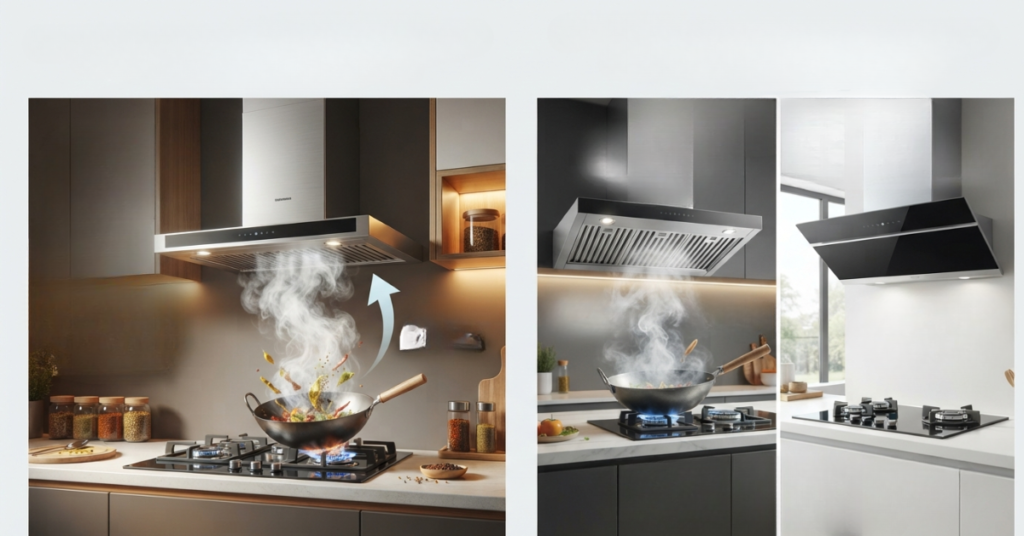
TL;DR: Choose a kitchen chimney with 1000–1200 m³/h suction and baffle filters to handle oily cooking, protect cabinets, reduce heat, and keep air fresh.
2026 Buyer’s Guide: Range Hoods vs Ventilation
Buying a range hood Choosing the right ventilation system requires evaluating heat output, grease generation, and ductwork constraints.
[ KITCHEN AIR EXHAUST SYSTEM ]
|
+————————+————————+
| |
[ DUCTED CHIMNEY HOOD ] [ RECIRCULATING HOOD ]
| |
External Wall Venting Charcoal Filter System
| |
+—————-+—————-+ +——-+——-+
| | | |
[BAFFLE FILTER] [SLANTED GLASS] [SLIM PROFILE] [TOUCH/SENSOR]
Heavy Frying & Spices Modern Aesthetics Compact Spaces Smart Controls
| Technical Feature | Baffle Filter Chimney Hood | Slanted Glass Auto-Clean Hood | Slim Recirculating Hood | Standard Kitchen Exhaust Fan |
| Primary Mechanism | Stainless curved baffle plates | Heating element + centrifuge | Activated carbon filter | Direct wall-blade extraction |
| Airflow Extraction Rate | $1000\text{ m}^3/\text{h}$ to $1400\text{ m}^3/\text{h}$ | $1100\text{ m}^3/\text{h}$ to $1350\text{ m}^3/\text{h}$ | $400\text{ m}^3/\text{h}$ to $700\text{ m}^3/\text{h}$ | $250\text{ m}^3/\text{h}$ to $400\text{ m}^3/\text{h}$ |
| Grease Separation Efficiency | High ($85\%\text{–}95\%$) | High ($80\%\text{–}90\%$) | Medium ($50\%\text{–}60\%$) | Low ($10\%\text{–}20\%$) |
| Noise Level Output | $55\text{ dB}$ – $68\text{ dB}$ | $52\text{ dB}$ – $65\text{ dB}$ | $60\text{ dB}$ – $72\text{ dB}$ | $65\text{ dB}$ – $78\text{ dB}$ |
| Duct Outlet Requirement | $150\text{ mm}$ ($6\text{ in}$) pipe | $150\text{ mm}$ ($6\text{ in}$) pipe | No ducting required | $200\text{ mm}$ wall hole |
| Ideal Application | Daily deep frying & heavy spice work | Open-plan kitchens & modern setups | Rental flats & interior walls | Utility balconies / basic sheds |
Proper Ventilation for Urban Bangladeshi Homes?
Buying a range hood South Asian cooking releases grease, smoke, VOCs, and steam from frying, mustard oil tempering, and spice roasting.
Buying a range hood In Dhaka and Chattogram apartments, poor ventilation allows oil residue to damage cabinets, ceilings, and kitchen surfaces over time.
Buying a range hood Installing an efficient chimney hood price in bd captures grease particles right at the cooktop, keeping indoor air fresh and cutting down post-cooking cleanup time.
+———————————————————————————–+
| KITCHEN AIRFLOW DIAGRAM |
| |
| +——————-+ +——————-+ +————-+ |
| | COOKING ZONE | | AIR EXTRACTION | | DISCHARGE | |
| | Heat, Oil Vapor, |–Smokey->| Baffle Filter Hood|–Ducting>| Exterior Wall| |
| | Spice Aromas | Plume | ($1200\text{ m}^3/\text{h}$) | Vent | |
| +——————-+ +——————-+ +————-+ |
+———————————————————————————–+
Core Technical Features to Evaluate Before Buying
Airflow Rate and Suction Power
Buying a range hood Air extraction is measured in cubic meters per hour (m³/h). For effective smoke and oil removal, choose range hoods with 1000–1200 m³/h suction power.
Buying a range hood Heavy frying requires up to 1350 m³/h to capture fumes quickly and prevent kitchen odors from spreading.
Filter Architecture: Baffle vs. Charcoal vs. Mesh
- Feature overlapping, curved steel blades that force smoke to rapidly change direction.
- Centrifugal force separates heavier oil droplets into collection cups while air moves through freely.
- They resist clogging, handle high thermal exposure, and are easy to clean by hand or in a dishwasher.
- Designed for ductless recirculating setups, using carbon granules to absorb odors and gaseous compounds.
- They do not discharge heat or moisture outside and require replacement every three to six months under active use.
- of layered wire mesh While effective for light boiling, mesh filters rapidly clog with heavy cooking oils.
- restricting airflow and creating potential fire hazards if not cleaned constantly.
Pro Tip: For mustard oil cooking and spice frying, choose stainless steel baffle filters over aluminum mesh to avoid grease buildup and airflow blockage.
Motor Quality, Self-Cleaning, and Acoustic Output
Buying a range hood Choose kitchen hoods with sealed copper motors and thermal overload protection for humid environments.
Buying a range hood Advanced models offer heat auto-clean systems that melt grease into an oil cup. Prefer quieter units below 65 dB for comfortable daily use.
Comparing Range Hood Types for Bangladeshi Kitchens
Wall-Mounted Chimney Hoods
Directly mounted above the cooktop against an exterior wall, wall-mounted chimney hoods offer wide coverage areas ($60\text{ cm}$ to $90\text{ cm}$) and high suction capacities.
Buying a range hood They accommodate rigid or flexible aluminum ducting through outer walls, making them ideal for heavy daily meal prep.
Slanted Glass and TV-Style Hoods
Buying a range hood Featuring an angled glass canopy, slanted hoods provide clear head clearance above the burners while adding a sleek, modern look.
Buying a range hood The angled canopy directs rising smoke into high-speed extraction vents, combining strong performance with easy-to-clean glass surfaces.
Slim Canopy and Under-Cabinet Hoods
Buying a range hood Designed for compact layouts, slim canopy models install directly beneath existing overhead cabinets.
While offering a space-saving profile, these models typically run at lower suction rates ($400\text{ m}^3/\text{h}$ to $700\text{ m}^3/\text{h}$) and are best suited for light cooking, reheating, or smaller rental apartments.
+———————————————————————————–+
| RANGE HOOD SELECTION FLOW CHART |
| |
| [ START: Assess Kitchen Layout ] |
| | |
| v |
| Is Ducting to Exterior Wall Possible? |
| / \ |
| (Yes) (No) |
| | | |
| v v |
| Heavy Spicy Frying? Select Recirculating |
| / \ [Slim Canopy Hood] |
| (Yes) (No) with Charcoal Filters |
| | | |
| v v |
| Select Select [Slanted Glass Hood] |
| [Baffle Hood] ($1200\text{ m}^3/\text{h}$) |
+———————————————————————————–+
Sizing, Mounting, and Installation Workflows
Matching Hood Width to Cooktop Dimensions
Buying a range hood To capture rising smoke effectively, the hood’s width should meet or exceed your cooktop’s overall burner width:
- 2-Burner Gas Stoves: Pair with a $60\text{ cm}$ ($24\text{ in}$) hood.
- 3 to 4-Burner Hob Units: Require a $75\text{ cm}$ to $90\text{ cm}$ ($30\text{ in}$ to $36\text{ in}$) hood to prevent side spillage of smoke plumes.
Clearance Heights and Duct Layouts
Buying a range hood Mount the hood base $65\text{ cm}$ to $75\text{ cm}$ ($26\text{ in}$ to $30\text{ in}$) above the gas stove surface.
Buying a range hood Mounting lower than $65\text{ cm}$ creates a heat hazard for internal components, while mounting above $75\text{ cm}$ reduces suction efficiency.
Buying a range hood Keep exhaust ducting short, using $150\text{ mm}$ ($6\text{ in}$) flexible aluminum piping with minimal sharp bends to maintain maximum airflow velocity.
Integrating Range Hoods with Kitchen Storage Workflows
Buying a range hood a well-planned kitchen layout relies on coordinated zones where storage, prep, and cooking work together seamlessly:
+———————————————————————————–+
| MODULAR KITCHEN ZONE SYSTEM |
| |
| +————————+ +————————+ +———————+ |
| | PREPARATION ZONE | | WASH ZONE | | COOKING ZONE | |
| | Multi-Layer Pull-Outs | | Double-Bowl Steel Sink | | Gas Stove + Range | |
| | Spice Racks & Baskets | | Under-Sink Organizers | | Hood Extraction | |
| +————————+ +————————+ +———————+ |
+———————————————————————————–+
Optimizing Prep and Cooking Zones
Buying a range hood positioning high-use items near the stove streamlines cooking and keeps workspace clear:
- Under-Stove Drawer Baskets: Heavy pots and stir-fry pans belong in dedicated deep pull-outs, such as a stove drawer basket price in bangladesh, keeping heavy cookware easily accessible.
- Spice & Seasoning Pull-Outs: Mounting slim vertical drawers beside the stove keeps oils and spices organized and off active counter space.
- Corner Storage Solutions: Rotating lazy susans or blind-corner units turn hard-to-reach cabinet corners into useful storage space.
Managing Wash and Utility Zones
Buying a range hood Properly designed sink stations keep excess moisture contained, protecting surrounding cabinetry from water damage:
- Under-Sink Baskets: Waterproof stainless steel racks keep cleaning products organized and off cabinet floors.
- Drying & Dish Racks: Tiered racks mounted above or beside deep double-bowl sinks keep prep counters clear of drying dishes.
Market Pricing, Warranty & After-Sales Support Guide
Buying a range hood Evaluating total ownership cost requires looking beyond upfront prices to consider energy use, replacement filters, and warranty coverage.
Price Range Breakdown in Bangladesh
- Covers basic $60\text{ cm}$ slim canopy or standard recirculating models with.
- lower suction capacity ($400\text{ m}^3/\text{h}$ to $700\text{ m}^3/\text{h}$) and push-button controls.
- Mid-Range Tier (BDT 20,000 – BDT 35,000): Features high-suction ($1000\text{ m}^3/\text{h}$ to $1200\text{ m}^3/\text{h}$) wall-mounted chimney hoods.
- touch controls, baffle filter systems, and thermal auto-clean functions. Look for top options under the best kitchen hood price in bd category.
- Premium models offer low-noise copper motors, motion-sensor gesture controls.
- slanted glass frames, smart touch panels, and high airflow capacity ($1300\text{ m}^3/\text{h}$+).
Warranty Terms and Service Requirements
Buying a range hood before purchasing, confirm that the manufacturer or retailer provides locally available replacement parts, including:
- Motor Warranty: Ensure coverage lasts 1 to 3 years.
- Circuit & Touch Panel Coverage: Verify 1 year of coverage against voltage fluctuations.
- Local After-Sales Support: Confirm available technical service and replacement parts, like oil collection cups, touch sensors, and spare baffle trays, to avoid maintenance delays.
Kitchen Exhaust Fan vs. Range Hood Comparison
Wall exhaust fans are cheaper but remove general room air. Built-in range hoods capture grease, smoke, and odors directly above the cooking area.
+———————————————————————————–+
| EXTRACTION METHOD COMPARISON |
| |
| EXHAUST FAN: Air pulled across room -> Wall Fan -> Grease settles everywhere |
| RANGE HOOD: Air captured at cooktop -> Baffle Filter -> Clean Air Discharged |
+———————————————————————————–+
Buying a range hood wall-mounted exhaust fans move smoke across the kitchen before venting, allowing grease to settle on cabinets and counters.
Buying a range hood a ducted range hood captures steam, oil, and heat directly above burners, improving air quality and keeping surfaces cleaner.
Installation Mistakes to Avoid
- Incorrect Duct Sizing: Reducing a $150\text{ mm}$ hood outlet down to a $100\text{ mm}$ pipe creates air backpressure, increases motor noise, and cuts suction power by over $30\%$.
- Excessive Pipe Bends: Installing flexible ducting with multiple $90^\circ$ turns restricts airflow, causes air turbulence, and lets oil collect inside the pipe folds
- Improper Mounting Height: Placing the hood base over $75\text{ cm}$ above the burners lets side drafts disperse smoke plumes before they reach the filter.
- Neglecting Make-Up Air: Running high-suction hoods in airtight, fully sealed kitchens without an incoming air vent creates a pressure vacuum that lowers extraction efficiency.
Step-by-Step Cleaning and Maintenance Guide
Buying a range hood Maintaining filter efficiency and motor performance requires a routine cleaning schedule:
+———————————————————————————–+
| MAINTENANCE SCHEDULE WORKFLOW |
| |
| [ DAILY / WEEKLY ] [ MONTHLY ] [ QUARTERLY ] |
| Empty & wash oil tray Soak & scrub baffle filters Run thermal auto-clean |
| Wipe front panel glass Clean external duct vent Inspect motor & wiring |
+———————————————————————————–+
Baffle Filter Cleaning Routine
- Remove Trays: Slide out the stainless steel baffle filters and drain the oil collection cup.
- Soak in Degreaser: Submerge filter plates in hot water mixed with liquid dish soap and baking soda for 20 to 30 minutes.
- Scrub and Dry: Gently clean between the baffle slats using a soft nylon brush, rinse thoroughly with warm water, and dry completely before reinstalling.
Operating Thermal Auto-Clean Cycles
Buying a range hood For auto-clean models, activate the heating cycle every 2 to 4 weeks based on daily cooking activity.
Buying a range hood High noise levels are usually caused by restricted ductwork, loose mounting brackets, or heavy grease buildup on the internal motor fan blades.
Buying a range hood Make sure your duct pipe diameter matches the manufacturer’s $150\text{ mm}$ specification and minimize sharp pipe bends during setup.
Choosing the Right Setup for Your Home
Buying a range hood Investing in a high-performance range hood transforms your kitchen into a clean, well-ventilated, and easy-to-maintain space.
Matching suction capacity to daily cooking habits and selecting durable stainless steel baffle filters protects cabinetry, preserves air quality, and ensures a comfortable environment for years to come.
Next Steps & Resource Directories
Browse Full Directories
[Main Hub] > [Kitchen Hood Directory]
Related Articles
- Kitchen Accessories in Bangladesh: Upgrade Your Home
- Kitchen Accessories Near Me: Smart Picks for Every Kitchen
- Kitchen Accessories Drawer: Smart Storage Solutions 2026
- Best Kitchen Accessories Holder for Smart Home Storage Now
