
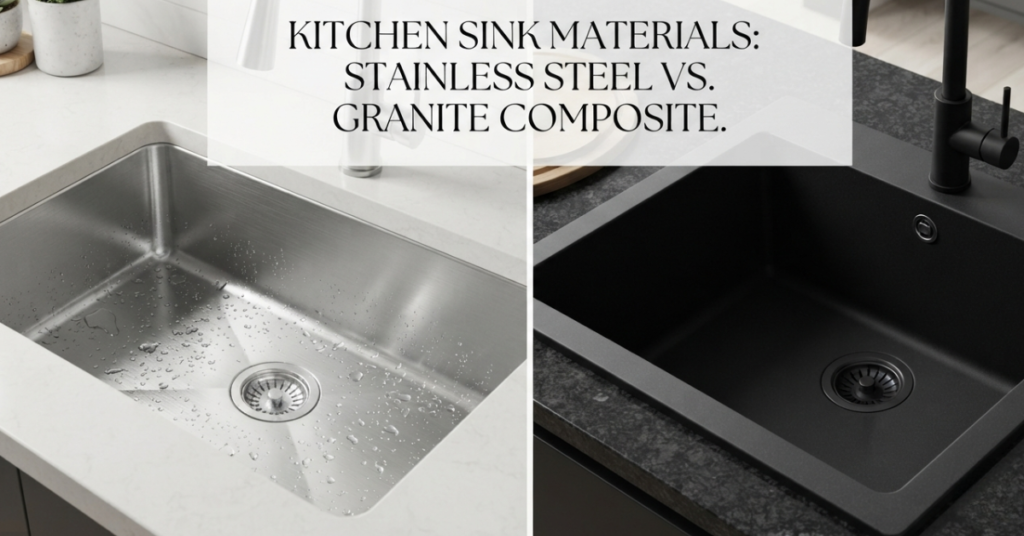
Best Kitchen Sink Materials Selecting the right kitchen sink material requires balancing physical durability, noise dampening, resistance to high-salinity water, and long-term maintenance.
Best Kitchen Sink Materials In heavy-use Bangladeshi households, cooking involves large aluminum cookware, abrasive spices, and frequent exposure to standing moisture.
Choosing 304-grade stainless steel or engineered granite composite prevents surface pitting, cabinet rot, and persistent water staining over years of daily wear.
Direct Comparison of Kitchen Sink Materials
[304 Stainless Steel]
├── High impact resistance
├── Impervious to thermal shock
└── Susceptible to water spotting & noise
[Granite Composite / Quartz]
├── Exceptional scratch & stain resistance
├── Superior acoustic insulation
└── Requires solid countertop support
[Fireclay & Ceramic]
├── Non-porous enamel finish
├── Classic aesthetic appeal
└── Risk of chipping under heavy impact
[Cast Iron with Enamel]
├── Maximum core durability
├── High heat retention
└── Heavy installation footprint
304-Grade Stainless Steel Sinks
Best Kitchen Sink Materials Stainless steel remains the most common choice for modern modular kitchens due to its tensile strength and resistance to cracking under heavy impact.
Key Takeaway:Use 16/18-gauge 304 stainless steel (18/8). Avoid 20/22-gauge—they flex, rust, and increase noise.
- Impact Resistance: Withstands dropped iron pans and heavy pressure without cracking or chipping.
- Maintenance: Requires regular wiping with neutral detergents to prevent hard water mineral scaling.
- Acoustic Profile: Requires undercoated rubber sound pads to absorb structural vibrations from running water.
Granite Composite and Quartz Sinks
Best Kitchen Sink Materials Engineered granite composite sinks consist of roughly 80% natural granite quartz mixed with 20% acrylic resin binder.
Best Kitchen Sink Materials This construction yields an extremely dense, non-porous structure resistant to chips and deep scratches.
- Stain Resistance: Resists deep penetration from turmeric, mustard oil, and dark sauces when wiped within reasonable timeframe.
- Thermal Endurance: Heat resistant up to 280°C, preventing surface discoloration from hot cooking vessels.
- Sound Absorption: Dense material structure naturally muffles water impact and utensil noise without extra insulation pads.
Fireclay and Ceramic Sinks
Fireclay sinks are crafted by molding clay under intense pressure and firing it at temperatures exceeding 1,200°C. This fuses the clay body with a durable enamel glaze.
- Hygiene: Non-porous vitreous surface resists bacterial growth and acid etching from citrus or vinegar.
- Aesthetic Integration: Complements traditional, farmhouse, or classic white kitchen designs.
- Weight Considerations: Requires heavy cabinet framing due to total material mass.
Cast Iron Sinks with Porcelain Enamel
Best Kitchen Sink Materials Cast iron sinks feature a heavy iron core coated with a fired porcelain enamel finish, yielding an extremely rigid fixture.
- Longevity: Iron base lasts for decades if the surface enamel remains uncompromised.
- Chipping Hazard: Dropping heavy metal utensils can chip enamel, exposing raw iron to rust if not promptly repaired.
- Installation Needs: Mandates reinforced cabinet bracing and solid substrate support underneath.
Technical Performance Matrix
Best Kitchen Sink Materials The performance of each material varies across critical operational factors in residential environments.
| Material Type | Heat Resistance | Scratch Resistance | Impact Durability | Acoustic Muffling | Average Lifespan |
| 304 Stainless Steel (16-Gauge) | High (Up to 300°C) | Moderate (Scratches merge into satin patina) | Maximum (Will dent rather than crack) | Moderate (Requires dampening pads) | 25+ Years |
| Granite Composite | High (Up to 280°C) | High (Resists metal scraper marks) | High (Can chip on sharp edge impact) | Maximum (Naturally quiet) | 15–20 Years |
| Fireclay / Ceramic | High (Up to 250°C) | High (Glaze resists fine abrasions) | Moderate (Prone to chipping from heavy impacts) | High (Dense body dampens noise) | 15–20 Years |
| Enameled Cast Iron | Moderate (Thermal shock can craze enamel) | Moderate (Scouring pads can dull gloss finish) | High (Heavy core, delicate coating) | High (Heavy mass stops resonance) | 20+ Years |
Evaluating Water Hardness, Salinity, and Local Conditions
Best Kitchen Sink Materials Water quality across Bangladesh presents specific challenges for kitchen plumbing fixtures.
Ground water in coastal belts and urban centers like Dhaka and Chittagong often contains elevated iron concentrations, lime scale, or high salinity.
[Tap Water Source]
├── High Salinity / Hardness ──> Chemical Oxidation Risk
│ ├── Low-Grade Steel (201/430) ──> Rapid Surface Pitting & Rust
│ └── 304 Stainless / Quartz ────> Superior Chemical Resistance
└── High Iron Content ─────────> Discoloration Risk
├── Porous Surfaces ───────────> Deep Metal Staining
└── Non-Porous Composite ──────> Easy Surface Clean-Up
Corrosion and Pitting Mechanisms
Best Kitchen Sink Materials Low-grade stainless steel rusts quickly in salty conditions. Genuine 304-grade steel forms a self-healing protective layer for lasting corrosion resistance.
Warning:Avoid harsh acids or bleach on stainless or granite sinks to prevent coating damage and pitting.
Managing Mineral Scaling and Staining
Best Kitchen Sink Materials Hard water leaves calcium and magnesium deposits (white scale) on dark sink finishes.
While quartz and granite composite materials resist chemical corrosion from hard water, dark matte finishes show dry mineral spots if left uncleaned.
Best Kitchen Sink Materials Selecting a brushed satin stainless steel or light gray composite sink minimizes the visibility of mineral buildup between deep cleans.
Integrating Your Sink into Modern Modular Kitchen Workstations
Best Kitchen Sink Materials A kitchen sink does not operate in isolation. It forms the core of the cleaning zone in the classic kitchen triangle (Sink, Cooktop, Refrigerator).
Best Kitchen Sink Materials Integrating functional accessories and dedicated storage turns the sink area into an efficient workstation.
[Preparation Zone] ──> [Washing Zone (Sink)] ──> [Cooking Zone (Hob)]
│
┌──────────────┴──────────────┐
▼ ▼
[Under-Sink Storage System] [Countertop Drainage Rack]
├── Pull-out wire baskets ├── Over-the-sink colander
└── Concealed waste bin └── Roll-up drying mat
Under-Sink Storage and Waste Management
The cabinet space directly underneath the sink bowl must accommodate drain traps, water purifier connections, and waste bins while remaining dry and organized.
- Installing anti-corrosive stainless steel pull-out drawer baskets inside under-sink cabinets keeps cleaning agents elevated off the floor.
- preventing moisture damage to cabinet carcasses.
- Use stainless steel drawer slides and soft-close hinges under wet zones to prevent rust caused by high cabinet humidity.
- Wall-mounted or door-attached PVC dustbins keep waste hidden, minimizing odors and maintaining clean floor spaces.
Over-the-Sink Workstation Accessories
Best Kitchen Sink Materials Modern modular sink systems use integrated ledge designs to double available prep space in smaller apartment layouts.
- Roll-Up Drying Racks: Stainless steel silicone-coated rods unroll across the basin to dry cookware directly over the drain, keeping countertops clear of water pools.
- Colanders and Cutting Boards: Custom-fit hardwood or composite cutting boards rest on sink ledges, allowing home cooks to chop, rinse, and dispose of scraps directly into the bowl.
- Dedicated Dish Drying Racks: Wall-mounted stainless steel dish racks positioned directly above the sink allow washed dinnerware to drip dry safely back into the basin.
Comparing Basin Styles: Single Bowl vs. Double Bowl Workstations
Best Kitchen Sink Materials Choosing between a single large basin or a divided double basin depends on daily cooking volume, countertop dimensions, and utensil sizes.
Single Basin Architecture
A single large basin (28 to 32 inches wide) provides uninterrupted floor space for washing oversized cookware, large rice cookers, Best Kitchen Sink Materials.
- Pros: Easily accommodates wide pots; visually clean profile; fits compact countertop footprints.
- Cons: Makes simultaneous soaking and rinsing difficult without secondary basins.
Double Basin Architecture
Best Kitchen Sink Materials A double basin split (either 50/50 or 60/40 ratio) separates prep activities from dirty cookware soaking.
- Pros: Allows simultaneous food washing and utensil soaking; keeps trash and food scraps separated.
- Cons: Center divider wall reduces lateral space for handling long-handled woks or wide baking sheets.
Step-by-Step Sink Installation and Countertop Mounting Guide
Best Kitchen Sink Materials Proper mounting methods preserve cabinet structures, prevent leaks, and dictate how easy it is to keep the surrounding counter clean.
1.Countertop Cutout and Clearance Verification:Step 1.
Before countertop cuts, verify cabinet rails, plumbing height, faucet clearance, and keep 2″ sink-to-wall clearance.
2.Substrate Preparation and Dry Fitting:Step 2.
Lower the sink into the raw cut out to check alignment, drain hole clearances, and level fit. Ensure the cabinet framing supports the full weight of the sink when filled with water.
3.Waterproof Sealant Application:Step 3.
Apply neutral-cure 100% silicone sealant evenly around the sink rim or flange. Avoid acidic silicone.
4.Mechanical Fastening and Leveling:Step 4.
Tighten mounting clips evenly in an alternating diagonal pattern starting from the center outward. Avoid over-tightening plastic or composite rims to prevent hairline cracking.
5.Plumbing Hookup and Pressure Testing:Step 5.
Install strainer, P-trap, disposal, and supply lines. Run water 10 min to check for leaks.
Common Mistakes to Avoid When Upgrading Your Kitchen Sink
Best Kitchen Sink Materials Investing in a high-quality sink material will not deliver long-term performance if installation or sizing errors occur during installation.
Common Mistakes
├── 1. Ignoring Cabinet Clearance Limits
├── 2. Using Incompatible Cleaners (Acid/Bleach)
├── 3. Selecting Thin Metal (20-22 Gauge)
└── 4. Inadequate Counter Support (For Heavy Granite/Cast Iron)
1. Purchasing Without Verifying Cabinet Base Width
Best Kitchen Sink Materials A common error is buying a 33-inch sink bowl for a 30-inch base cabinet.
The outer dimensions of the sink basin must always be at least 3 inches smaller than the interior width of the sink cabinet to allow mounting hardware clearance.
2. Selecting Thin-Gauge Metal Sinks
Best Kitchen Sink Materials Inexpensive stainless steel sinks constructed from thin 20-gauge or 22-gauge metal flex under the weight of water-filled pots.
This movement breaks the silicone seal along the countertop perimeter, allowing water to leak into lower cabinets and warp plywood structures.
3. Neglecting Sound Isolation Pads
Best Kitchen Sink Materials Installing an uninsulated stainless steel sink results in loud echoing whenever water runs or utensils contact the metal.
Ensure your chosen model includes factory-applied rubber acoustic pads and an undercoating spray to prevent condensation dripping into the cabinet.
Kitchen Sink Maintenance Schedule
Best Kitchen Sink Materials To extend the lifespan of your sink fixture and maintain its surface finish, follow this structured care schedule based on material chemistry.
| Material | Daily Routine | Monthly Deep Clean | Avoid Completely |
| Stainless Steel | Rinse thoroughly; wipe dry with microfiber cloth after use. | Apply specialized stainless cleaner; scrub with the metal grain direction. | Steel wool pads, harsh acids, standing bleach mixtures. |
| Granite Composite | Wash with neutral dish soap; rinse off oil and food residues. | Scrub with baking soda paste; apply mineral oil to restore matte lustre. | Wire brushes, abrasive scouring powders, drain lye. |
| Fireclay / Ceramic | Clean with soft sponge and mild liquid detergent. | Apply diluted vinegar solution to remove hard water scale buildup. | Abrasive scrubbers that scratch protective surface glazes. |
Selecting from the best kitchen sink materials requires balancing material density, water quality challenges, and structural support within your modular kitchen footprint.
