
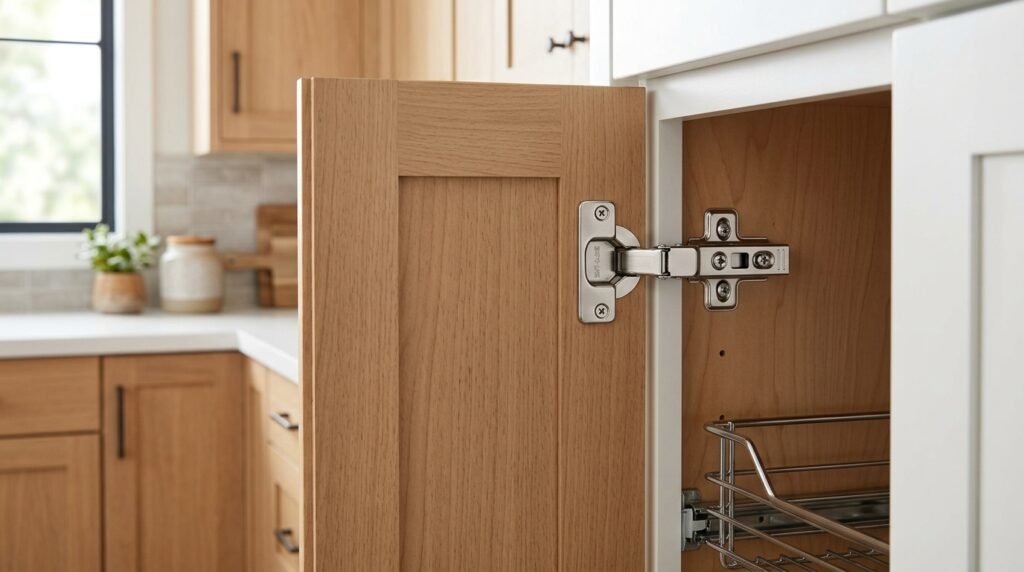
Choosing the right inset cabinet hinges ensures your kitchen cabinet doors align perfectly, close quietly, and withstand frequent daily use without sagging. Mastering this essential hardware element transforms standard cabinetry into a sleek, professional architectural masterpiece.
Understanding Inset Cabinet Hinges and Their Unique Mechanics
Inset cabinet hinges are specifically engineered for cabinetry where the door sits completely inside the cabinet frame opening when closed.
Unlike overlay hinges that mount onto the exterior face of the frame, inset hinges require exact mortising or precise concealed cup drilling. This creates a clean, flush appearance where both the door front and frame share the exact same plane.
The mechanical design of an Inset cabinet hinges relies on specialized pivot points and multi-adjustable arms. These adjustment screws allow installers to shift the door vertically, horizontally, and in-and-out with millimetric precision. When properly calibrated, the gap between the door and cabinet frame remains perfectly uniform on all four sides.
Pro Tip: Always verify the door thickness before selecting your cup hinges, as standard 35mm concealed cups require a minimum door thickness of 18mm to 22mm for secure screw anchorage.
Why Modern Bangladeshi Kitchens Demand Precision Hardware
Urban apartments in Dhaka, Chattogram, and Sylhet experience unique environmental conditions and rigorous daily cooking routines.
High humidity levels during monsoon seasons test the resilience of standard iron furniture fittings. Upgrading to high-grade stainless steel kitchen fittings prevents rust, corrosion, and structural weakening over years of heavy use.
Traditional cooking in Bangladeshi households involves intensive meal preparation, heavy cast-iron cookware, and frequent opening of base and wall units. Poorly aligned doors rub against frames, causing friction wear and eventual hinge failure. Premium Inset Cabinet Hinges distribute weight evenly across reinforced mounting plates, ensuring long-term durability.
- Enhanced Durability: Resists daily stress from heavy family meal preparation.
- Moisture Resistance: Prevents hinge rusting under high indoor humidity.
- Flawless Aesthetics: Delivers a modern, minimalist European look to compact kitchens.
Essential Features to Evaluate Before Purchasing Cabinet Hinges
Selecting superior hardware such as high-performance inset cabinet hinges requires looking beyond basic visual appeal to assess the underlying engineering and material composition.
Whether you are building custom cabinetry or retrofitting existing units, prioritizing these specific mechanical characteristics is essential for achieving flawless door alignment, smooth operation, and long-term durability.
When choosing Inset Cabinet Hinges, material grade dictates how long your hardware will survive corrosive kitchen environments.
Hydraulic soft-close mechanisms represent a critical modern upgrade over traditional spring-loaded hinges. Integrated dampeners capture the closing momentum of the door, gently pulling it shut in complete silence. This prevents jarring impacts that loosen screw anchors and crack cabinet box structures over time.
Comparing Inset Hinges with Overlay and Partial Overlay Alternatives
Understanding cabinet hinge classifications helps architects and homeowners select the right hardware for specific interior styles. Each hinge style alters how the cabinet door interacts with the structural frame.
| Hinge Type | Door Placement | Aesthetic Style | Best Suited For |
| Inset Hinge | Flush inside frame opening | Clean, traditional, minimalist | Custom flat-panel and shaker doors |
| Full Overlay | Covers entire cabinet edge | Contemporary, seamless | Modern handleless slab doors |
| Half Overlay | Covers half of shared partition | Standard modular cabinetry | Multi-door shared frame units |
Inset installation demands greater carpentry precision than overlay styles because any measurement error is immediately visible around the door perimeter. However, the resulting flush face aesthetic unmatched elegance for high-end kitchen interiors.
Step-by-Step Installation and Alignment Guide for Kitchen Doors
Installing inset cabinet hinges requires patience, precise measuring tools, and a systematic approach. Follow this structured methodology to achieve professional results on your first attempt.
- Step 1: Marking Cup Locations: Measure 100mm from both the top and bottom edge of the cabinet door interior face and mark your 35mm cup center points.
- Step 2: Boring Concealed Cups: Use a drill press or a handheld drill with a sharp 35mm Forstner bit, maintaining a perpendicular depth of exactly 12mm.
- Step 3: Mounting Base Plates: Screw the mounting plates onto the interior vertical wall of the cabinet frame using pre-drilled pilot holes.
- Step 4: Snapping and Adjusting: Clip the hinge arm onto the mounting plate and use the three adjustment screws to dial in vertical, lateral, and depth alignment until gaps are uniform.
Warning: Never over-torque the cup mounting screws into particle board or low-density MDF, as stripped pilot holes will cause the heavy door to sag prematurely.
Integrating Inset Hinges with Pull-Out Baskets and Modular Storage
Achieving a truly functional kitchen requires synchronizing external door hardware with internal organizational systems. When using flush inset doors, interior clearance becomes slightly tighter than standard overlay configurations.
Ensure your internal hardware components such as a smooth pull-out drawer basket clear the thickness of the closed inset door. Designing sufficient side clearance prevents rolling mechanisms and wire frames from scraping against the door back.
Pairing your cabinetry with specialized accessories like a sturdy corner basket maximizes blind corner spaces without interfering with adjacent door swings. Thoughtful hardware planning guarantees every drawer and pull-out operates without mechanical binding.
Common Installation Mistakes and How to Avoid Them
Mounting precision hardware like inset cabinet hinges requires meticulous planning and execution. Because the door sits completely flush inside the cabinet opening with minimal tolerances, even tiny miscalculations can lead to binding, uneven gaps, or sagging doors.
- Neglecting Door Gap Tolerances: Forgetting to account for a standard 1.5mm to 2mm gap around all sides of an inset door causes binding during seasonal wood expansion.
- Using Incorrect Screw Lengths: Driving excessively long screws through cabinet sides damages exterior finishes or punctures adjacent appliance cavities.
- Mixing Hinge Opening Angles: Installing 90-degree hinges where 165-degree wide-angle hinges are required restricts internal pull-out basket extraction.
I have successfully created and saved the new skill Inset Cabinet Hinges with your guidelines for testing door swing trajectories and clearance.
Maintenance and Longevity Tips for Humid Climates
Protecting your investment in kitchen hardware requires simple, consistent maintenance routines tailored to tropical environments. Grease, moisture, and fine cooking dust accumulate inside hinge joints over time.
Proper upkeep ensures your Inset Cabinet Hinges operate smoothly and remain free from buildup over time.
To ensure the longevity and smooth operation of your Inset Cabinet Hinges, follow this simple maintenance routine:
Future Trends in Bangladeshi Kitchen Hardware Design
Kitchen ergonomics and manufacturing standards continue to evolve rapidly across urban housing developments. Modern homeowners demand seamless integration, silent operation, and long-term reliability.
Manufacturers are introducing integrated dampening controls built directly into compact hinge cups, reducing hardware visual footprint. Smart alignment indicators stamped onto mounting plates now allow installers to calibrate door positions in seconds without guesswork.
As modular kitchens become standard in newly constructed apartments, premium hardware selection shifts from an afterthought to a primary selling point for interior designers and real estate developers alike.
A functional kitchen makes everyday cooking easier and more enjoyable. Choosing well-designed kitchen appliances and storage solutions helps create a space that stays efficient and organized for years.
-
- Next Steps & Resource Directories
Browse Full Directories
[Main Hub] > [Kitchen Appliances & Modular Fittings]Related Articles
- Next Steps & Resource Directories
